
What hygiene features matter in cosmetic liquid filling machines?
Time : Nov 18, 2026
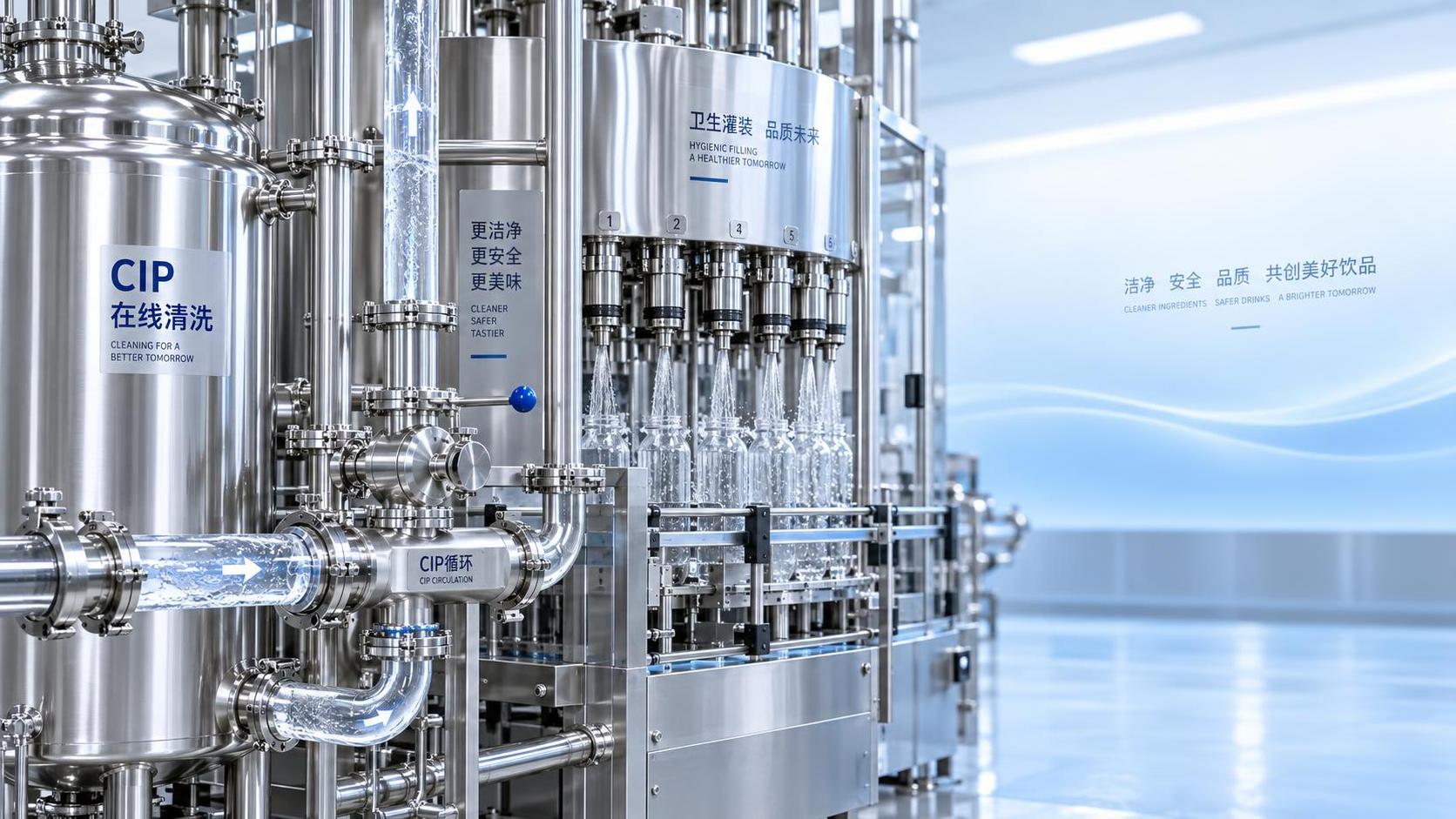
Hygiene in a Cosmetic Liquid Filling Machine is determined by the condition of every product-contact path, the machine’s ability to be cleaned repeatedly, and the extent to which its design prevents residues, microbes, foreign matter, and cleaning chemicals from reaching the finished product. A polished external frame is not enough. The relevant question is whether product can remain trapped in a valve, hose connection, pump chamber, filling nozzle, tank outlet, or gasket interface after draining and cleaning.
Cosmetic liquids create different hygiene challenges. Low-viscosity toners and micellar products can travel into narrow crevices and leak through poorly sealed joints. Creams, gels, serums, and suspensions can leave films on internal surfaces, especially at low-flow zones or around valve seats. Formulas containing oils, waxes, botanical extracts, proteins, pigments, or suspended particles often require closer attention because their residues may be harder to remove and can interfere with visual inspection. Hygiene features therefore need to match the actual formula range, changeover frequency, cleaning method, and filling environment.
Product-contact materials and surface condition
All wetted components should be made from materials compatible with the product and the intended cleaning chemistry. Stainless steel is widely used for tanks, pipes, pumps, manifolds, and filling needles because it is durable, cleanable, and resistant to many cosmetic formulations. However, specifying stainless steel alone does not establish a sanitary design. The grade, finish, weld quality, elastomer selection, and construction of each contact component matter.
Internal surfaces should be smooth, continuous, and free from visible pits, cracks, burrs, sharp internal shoulders, and damaged polishing. Rough or poorly finished surfaces retain product films more easily. This is especially relevant where thick lotions or emulsions are filled, because a seemingly clean system may still hold material within microscopic irregularities or around incomplete welds. Surface finish claims should be supported by a defined specification and applied to the wetted path, rather than only to accessible tank interiors.
Welds deserve close examination. A hygienic weld is consistent with the surrounding pipe bore and does not create a ridge or pocket inside the line. Ground external welds can look neat while an internal weld bead remains difficult to clean. Orbital welding, documented weld procedures, and internal inspection records can provide stronger evidence for critical piping sections, although the appropriate level of documentation depends on the installation and process risk.
Seals, O-rings, diaphragms, flexible hoses, and valve seats should also be reviewed as product-contact materials. An elastomer that is chemically stable with water may swell, crack, or absorb fragrance oils. Conversely, a seal chosen for solvent resistance may have limited suitability for high-temperature sanitation. Material compatibility must cover the formula, preservatives, fragrances, alcohol content, cleaning agents, rinse water, and the expected temperature range. A seal can remain intact yet retain odor or color from a previous batch, which is a changeover concern rather than a simple mechanical failure.
Drainability is a hygiene feature, not a convenience
A filling path should drain predictably when product transfer stops. Residual liquid becomes a hygiene problem when it sits in a horizontal pipe run, a pump cavity, a pressure sensor branch, a long nozzle body, or the bottom of a manifold. It can dry, separate, or remain in contact with a later formula. It also makes cleaning validation less reliable because the rinse stream may bypass the retained pocket.
Complete drainability requires more than sloping pipework. The arrangement of valves, tees, sample ports, reducers, flow meters, filters, and flexible connections must be considered as one route. A line that drains well with water may retain a viscous cream. Likewise, a system that empties during production may not drain after cleaning if the cleaning solution follows a different route or uses lower flow velocity.
Dead legs are a common design weakness. A dead leg is a branch where flow is weak or absent and where product or cleaning fluid can remain after the main line is drained. Short instrument connections and necessary sensor ports are not automatically unacceptable, but their geometry must be limited and their cleaning exposure demonstrated. Long capped branches, redundant valves, and unused sample points add cleaning uncertainty without improving filling performance.
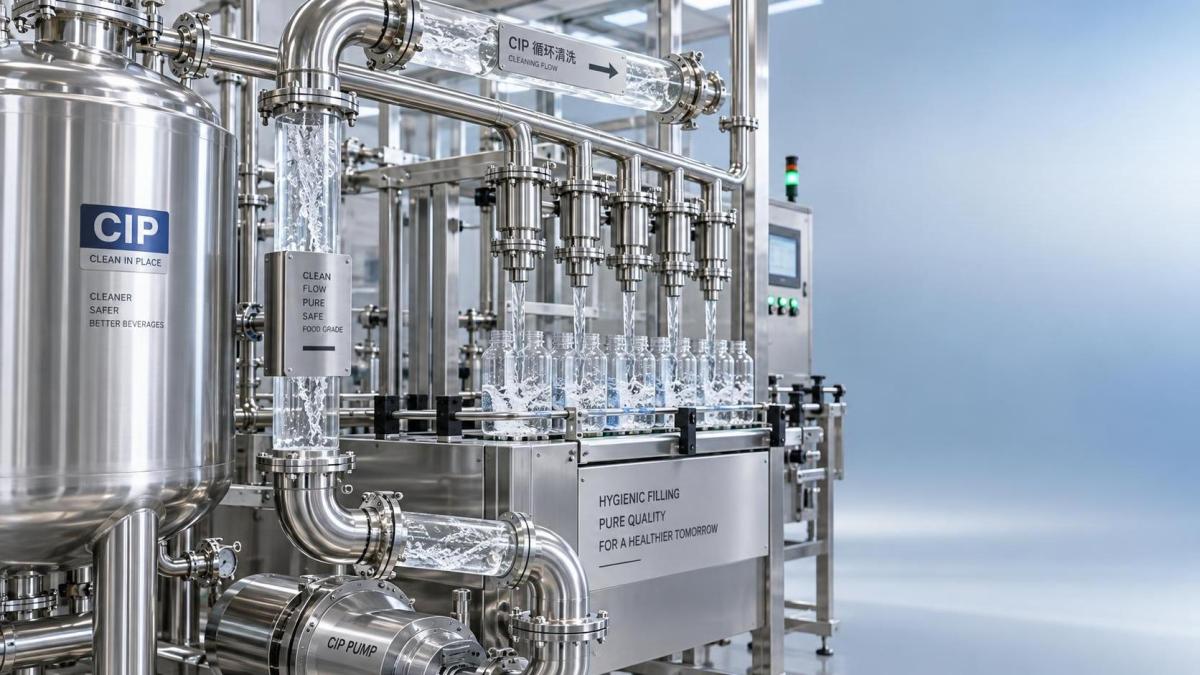
Filling nozzles require the same scrutiny as the main product line. Nozzle tips can collect strings of product, aerosol deposits, and splashes from the container opening. A hygienic nozzle design has smooth internal geometry, minimal threaded product-contact zones, and a mechanism that permits access for cleaning or supports validated clean-in-place circulation. Anti-drip functions should be assessed carefully: they reduce trailing product, but spring-loaded parts, shutoff needles, and small internal chambers can introduce areas that need thorough cleaning.
Clean-in-place capability must reflect the actual circuit
Clean-in-place, often called CIP, is valuable when the machine is designed so cleaning solution reaches every wetted surface at suitable flow, temperature, contact time, and concentration. A machine advertised as CIP-capable is not necessarily fully cleanable in its installed configuration. The pump, balance tank, filtration housing, recirculation loop, filler manifold, and nozzles must all be included in the intended cleaning circuit.
The most useful technical review is a route-by-route drawing of production flow, product recovery flow, cleaning circulation, rinse flow, and drainage. This exposes components that are bypassed during cleaning, such as manual valves left in the wrong position, piston cylinders that cannot be swept, or nozzles that are only externally rinsed. It also clarifies whether the machine can clean at the required pressure without forcing seals open or bypassing a control valve.
Spray devices inside tanks should match the tank geometry and soil type. A spray ball may wet the interior surface but may not provide sufficient mechanical action for tenacious residues. A rotating spray device can improve coverage in larger vessels, yet it still needs adequate supply pressure and flow. Shadowed regions under agitator mounts, level probes, tank lids, and internal brackets should be considered during design review. The presence of a spray device is evidence of intent; coverage and repeatability are what establish its hygiene value.
For small-batch or frequently changed cosmetic products, partial disassembly may remain necessary even when CIP is available. This is not a design failure if the components can be removed without tools that damage surfaces, without hidden reassembly errors, and without exposing inaccessible threads. Hygienic construction supports quick inspection as well as automated cleaning.
Closed transfer and contamination control around the filler
Product hygiene can be lost after an effective tank and pipe cleaning cycle if the transfer and filling zone are exposed unnecessarily. Closed product transfer from preparation vessel to filler reduces contact with ambient dust, accidental splashes, and handling-related contamination. Connections should use sanitary fittings with correctly seated gaskets rather than improvised adapters or difficult-to-clean threaded joints in the product path.
Tank covers, vent filters, and pressure equalization arrangements deserve attention. A vent opening is a potential entry point when the tank level changes or when cleaning causes pressure fluctuations. Where filtered venting is required, the filter housing must be accessible for replacement and positioned so condensate or cleaning liquid does not compromise its performance. An unprotected open tank may be workable for a very short, controlled operation, but it creates a different hygiene exposure than a closed filling circuit.
The filler enclosure and surrounding machine layout also affect cleaning outcomes. Product drips can accumulate beneath nozzles, on bottle guides, under conveyor rails, or inside guard frames. These areas are not always product-contact surfaces, yet dried residue can become a source of splash, aerosols, insects, or housekeeping failures. Open structural tubing, horizontal ledges, inaccessible fasteners, and tightly packed cable routes create avoidable soil traps. Frames with sealed or open-and-drainable construction are easier to inspect than structures that conceal liquid inside hollow members.
Air used near product or containers should be evaluated according to its function. Air that actuates a cylinder outside the product zone does not carry the same risk as air used to blow-clean a container or contact an open product surface. Where compressed air has direct product or package exposure, filtration, condensate control, line maintenance, and point-of-use condition become relevant. The presence of an air filter alone does not show that the delivered air remains suitable after passing through older downstream piping.
Design details that support reliable cleaning
Easy cleaning is strongly linked to access. Guards, panels, and conveyor components should allow observation of drip zones and product-contact assemblies without creating unnecessary dismantling work. When a filling valve must be removed for inspection, the design should make its correct reassembly clear. Reversed seals, misaligned diaphragms, and overtightened clamps can create leaks or crevices after maintenance.
- Sanitary connections: Clamp-style fittings with suitable gaskets are generally easier to inspect and clean than product-contact threaded couplings. Their hygiene value is lost when clamps are damaged, gaskets are cut, or fittings are misaligned.
- Accessible filters: A product filter can protect the filler from particles, but its housing must drain and open fully for inspection. A filter left in service after a formula change can hold a concentrated residue that later enters the batch.
- Removable nozzle assemblies: For formulas prone to buildup, removal should expose internal channels and sealing surfaces. External wiping cannot confirm the cleanliness of a narrow nozzle passage.
- Controlled lubricant separation: Bearings, gearboxes, and pneumatic components should be arranged so lubricants cannot drip or migrate into product-contact or open-container zones.
Maintenance design and hygienic design are closely connected. A difficult-to-reach valve is more likely to receive incomplete inspection. A worn piston seal can create both filling variation and a residue pocket. A pump with damaged internal surfaces may continue to move product while becoming increasingly difficult to clean. Maintenance records should therefore connect part replacement, cleaning observations, leak events, and product deviations rather than treating them as unrelated activities.
Filling accuracy does not prove hygienic performance
A machine can deliver stable fill volumes and still be unsuitable for a hygiene-sensitive process. Fill accuracy measures dosing consistency; hygiene depends on cleanable geometry, material condition, contamination control, and cleaning execution. These characteristics should be evaluated separately during equipment acceptance.
Negative-pressure filling systems illustrate why the process principle matters. Vacuum or pressure balancing may suit certain low-viscosity liquid applications, but the associated product path, return route, vacuum interfaces, and container-contact arrangement must be assessed for cleanability. Similar questions apply when reviewing equipment such as a Negative Pressure Fully Automatic Wine Filling Production Line: the filling method may differ from a cosmetic application, while sanitary fundamentals such as drainable product circuits, smooth contact surfaces, and controlled cleaning routes remain relevant.
Product characteristics change the importance of individual features. A clear water-based liquid may reveal carryover through color or odor changes quickly. An opaque emulsion can conceal small residues, making visual confirmation less meaningful. High-viscosity products place more emphasis on pump design, line diameter, drain time, and the ability of cleaning solution to displace adhered material. Alcohol-containing liquids raise material compatibility and vapor-control considerations. Products with suspended particles can accumulate at valve seats, filters, and low points even when the bulk line appears clean.
Verification should look beyond a visual rinse
A clear final rinse is useful but incomplete evidence. Water may leave a line looking clean while formula residues remain in seals, pumps, filters, or dead-end branches. Verification methods should be selected according to the residue risk and the cleaning process. Visual examination is valuable for accessible surfaces; it is less useful for enclosed circuits. Conductivity, pH, rinse appearance, swab testing, microbiological monitoring, or residue analysis may be appropriate where supported by the site’s cleaning approach and product requirements.
Sampling points need careful placement. A sample taken from a convenient outlet may only show that the main pipe is clean. It does not necessarily represent the hardest-to-clean valve, nozzle, filter housing, or return branch. During qualification, difficult locations should be identified deliberately. The worst-case product is not always the thickest product; a strongly fragranced oil, pigmented serum, sticky gel, or preservative-sensitive formula can create a more demanding cleaning challenge.
Repeated cleaning cycles also reveal issues that a one-time factory demonstration may not show. Gaskets can lose shape, clamps can be overtightened, spray devices can become obstructed, and manual cleaning steps can vary between shifts. Hygienic performance should remain repeatable after normal maintenance, planned changeovers, and realistic production interruptions.
The most defensible equipment choice is one in which the product-contact route can be seen, understood, drained, cleaned, inspected, and restored without relying on assumptions. When those conditions are built into the filler, hygiene becomes a controllable part of the process rather than a problem discovered after product has entered the line.
Leave A Message
If you are interested in our products and want to know more details, please leave a message here, we will reply you as soon as we can.