
How to stop bottle jams at an unscrambler infeed
Time : Oct 16, 2026
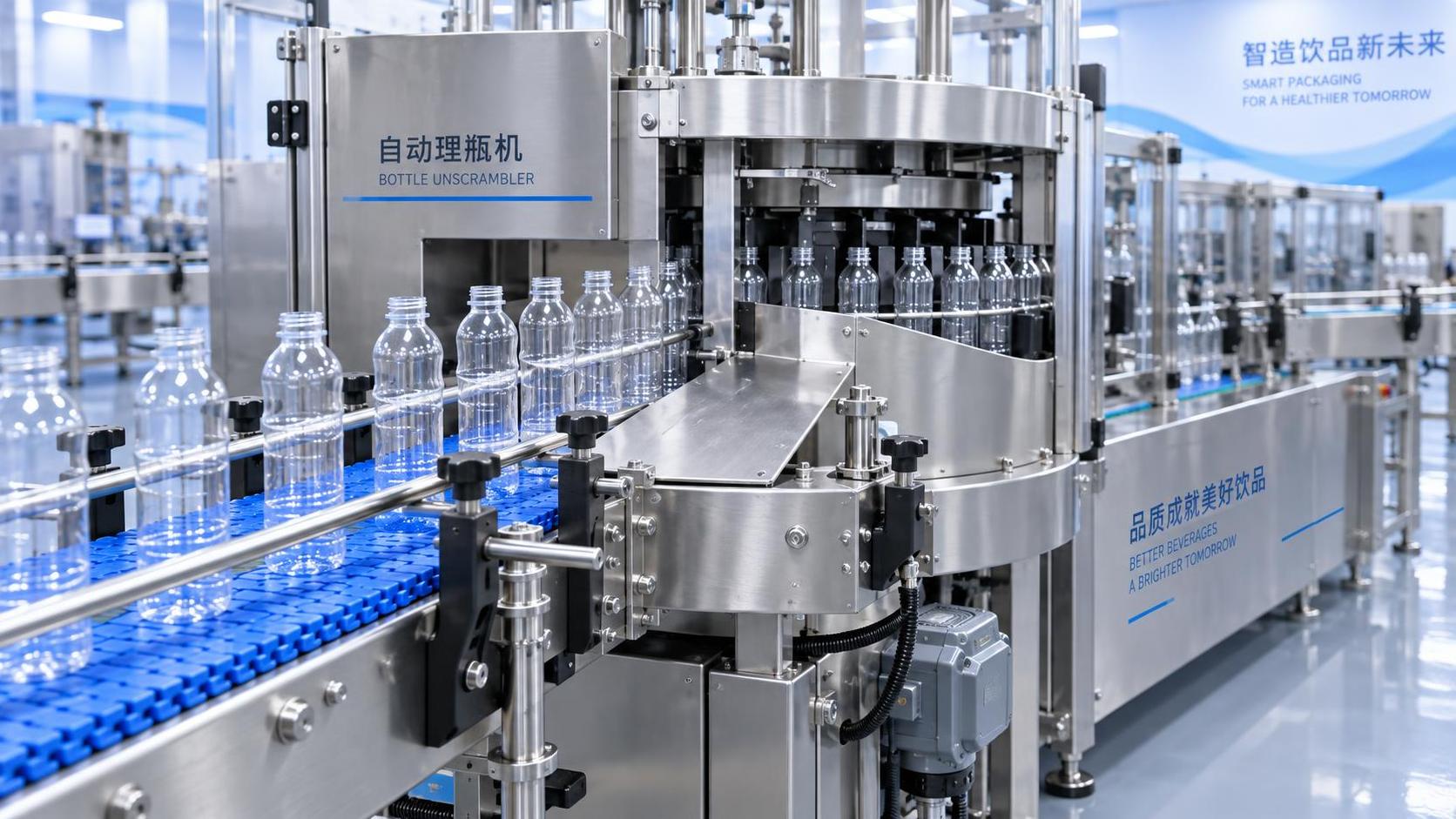
A bottle jam at an unscrambler infeed is rarely caused by one “bad bottle.” It is usually the visible result of an unstable bottle stream: containers arrive too quickly for the available space, lose the orientation needed to travel forward, or encounter a transfer point that no longer matches the bottle’s shape and rigidity. Clearing the blockage restores production for a moment; correcting the flow condition prevents it from returning.
The most useful way to troubleshoot an infeed jam is to identify where the bottle motion first becomes uncontrolled. Watch the last few seconds before the jam rather than only the pile-up itself. Do bottles stop moving at the hopper discharge? Do they bridge across a narrow conveyor? Do they overlap at a guide rail transition? Do they enter the unscrambler but fail to settle into the machine’s handling system? Each pattern points to a different correction.
Recognize the jam pattern before changing machine settings
“Bottle jam” can describe several different failures. Changing conveyor speed, guide width, air pressure, and unscrambler settings at the same time makes diagnosis harder. Start by separating the common patterns.
- Bridging: Bottles form an arch or locked cluster across the infeed. This is common with lightweight PET bottles, square containers, tall narrow bottles, and bottles with a large diameter change between body and shoulder.
- Overlapping or nesting: One bottle rides partly over another, often after a sudden speed reduction or a poorly controlled accumulation zone. Flexible empty bottles are especially prone to this.
- Sideways crowding: Bottles reach the infeed faster than the machine can accept them and begin to rotate, press against side rails, or travel sideways instead of longitudinally.
- Transfer-point hang-up: A bottle catches at the gap between conveyors, at a dead plate, or where guide rails change position. The rest of the flow then stacks behind it.
- Intermittent stoppage with one bottle format: The equipment may run one container reliably but jam after a format change. This often indicates that the bottle’s actual geometry does not match the installed guides, rails, discs, belts, or orienting components.
A recurring jam in the same location is valuable evidence. Mark the exact point where the first bottle loses stable travel. The upstream pile is a consequence; the first unstable bottle is the fault to investigate.
Control accumulation instead of forcing more bottles into the infeed
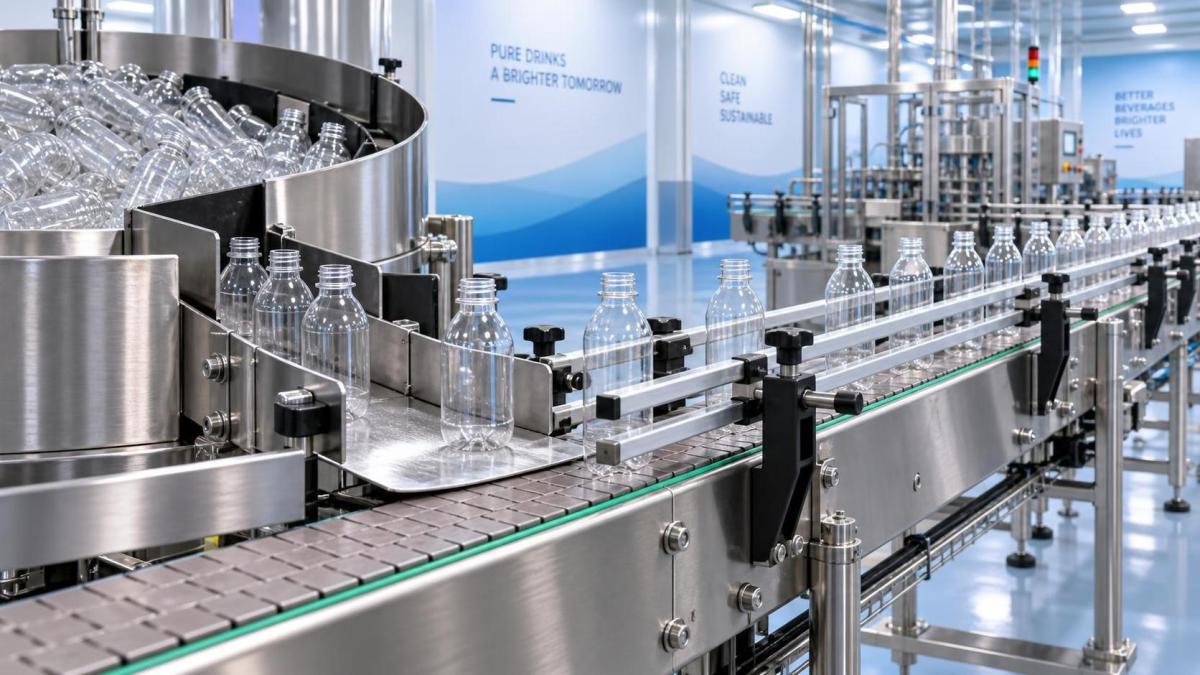
Overfeeding is one of the most common reasons an unscrambler infeed becomes unreliable. An unscrambler needs a controlled supply of loose bottles, not a compressed mass. When containers arrive in a dense pack, they cannot separate and present themselves consistently to the machine’s orienting section. Increasing the feed rate may appear to improve output for a short period, but it often creates more frequent stops and longer recovery time.
The incoming bottle layer should have enough freedom for individual containers to rotate and separate without climbing over each other. This requirement becomes stricter as the bottle becomes lighter, taller, more tapered, or less symmetrical. A heavy, rigid round bottle can tolerate more contact than a thin-wall PET bottle with a shaped waist or offset base.
Check whether the upstream conveyor is delivering bottles in pulses. Pulsing can occur when an accumulation conveyor alternates between running and stopping, when a sensor signal has too much delay, or when an upstream machine releases batches rather than a steady stream. The Bottle Unscrambler may be correctly adjusted yet still jam if it receives repeated surges followed by empty gaps.
A practical adjustment sequence is to reduce the upstream feed until the bottle mass moves smoothly, then increase it gradually while observing the point at which bottles begin to overlap or bridge. The highest possible incoming rate is not necessarily the best operating rate. The useful setting is the one that allows the unscrambler to maintain a stable discharge without repeated intervention.
Match conveyor speed to the unscrambler’s acceptance rate
Speed synchronization is more important than maximum conveyor speed. The infeed conveyor, hopper discharge, unscrambler entrance, and downstream discharge must pass bottles from one control zone to another without abrupt compression or separation.
If the conveyor immediately before the unscrambler runs faster than the receiving section, bottles accumulate at the entrance. If it runs too slowly, the machine may experience bottle starvation, which can reduce output or create irregular operation. The correct balance is usually a lightly supplied infeed with consistent bottle availability, not a tightly packed queue pressing continuously against the machine.
When a jam develops at a transfer, compare the surface speeds on both sides. A speed difference can be intentional where bottles need to separate, but it must be appropriate for the container. For example, a moderate increase in downstream speed can create useful spacing for stable round bottles. The same difference can pull a lightweight, unstable bottle sideways or cause it to tip if the guide geometry is not supportive.
Do not judge synchronization only by the drive frequency shown on each motor controller. Conveyor belt diameter, gearbox ratio, belt condition, slipping chains, and wear can cause the actual surface speed to differ from the displayed setting. Observe bottle behavior over the transfer point. A smooth handoff has no sudden bottle compression, no visible hesitation, and no repeated contact with the same rail edge.
Set guide rails for guidance, not confinement
Side guides keep bottles on a predictable path, but guides that are too narrow create friction and turning forces. Guides that are too wide allow bottles to rotate, travel diagonally, and collide with other containers. The right setting depends on bottle diameter, shape, center of gravity, and the position of ribs, labels, handles, or embossed features.
For a round bottle, the rail spacing should prevent lateral wandering while allowing the bottle to advance without continuous high-pressure contact. For square, rectangular, or oval bottles, the critical issue is not only nominal width. Corners can catch on rail joints, and bottles can rotate into a position that occupies more transverse space than expected. A guide setting that appears correct with stationary bottles may fail once containers begin to move and contact one another.
Inspect rail transitions closely. A small step between rail sections, a loose bracket, a damaged plastic rail, or an exposed fastener can repeatedly disrupt bottle travel. These defects may not stop rigid containers, but they can catch lightweight bottles or create enough resistance for a following bottle to push the first one sideways.
Guide rails should also be checked for height. If rails contact a tapered shoulder, an irregular bottle body, or a flexible panel instead of a stable cylindrical section, the bottle can tilt or rotate. Rail contact is most stable around a portion of the bottle that remains dimensionally consistent during conveying.
Inspect the transfer hardware that bottles actually touch
Many jam investigations focus on controls while overlooking mechanical contact points. Empty bottles are sensitive to small changes in friction, gaps, alignment, and surface condition. A damaged dead plate, worn conveyor chain, loose wear strip, or uneven guide can turn a normal transfer into a recurring infeed obstruction.
During a planned stop, inspect:
- the gap between adjacent conveyors or between the conveyor and the unscrambler entry;
- dead plates for burrs, sharp edges, deformation, or a height difference relative to the conveyor surface;
- chain tracks and belts for damaged links, contamination, excessive wear, or inconsistent tension;
- guide rail joints, supports, and fasteners for movement or misalignment;
- infeed discs, belts, fingers, or orienting elements for wear that reduces positive bottle control;
- accumulated dust, label fragments, plastic debris, lubricant residue, or moisture that changes friction.
Cleaning is not merely a housekeeping activity. Dust and plastic fines can alter the sliding behavior of lightweight bottles, while excessive lubricant can make containers drift or rotate too easily. Use only the cleaning and lubrication practices specified for the conveyor materials and the bottle handling system. A surface that feels smooth by hand can still be unsuitable if it causes bottles to slide unpredictably under production conditions.
Bottle condition can be the source of an apparent equipment fault
When jams begin after a delivery of bottles, after a preform or mold change, or only with a particular supplier’s containers, inspect the bottle itself before making major machine changes. The infeed system is designed around certain assumptions about bottle dimensions and stiffness. Changes that remain within a broad drawing tolerance can still affect conveying performance.
Useful checks include bottle height, body diameter, base shape, neck finish, ovality, wall thickness, flash, deformation, and static charge. A bottle that is slightly oval may roll or slide differently from a round one. A lighter bottle may collapse or climb under side pressure. A modified shoulder profile can contact the rails at a new location. Bottle-to-bottle variation also matters: a line may run acceptably until a smaller or distorted container creates the first gap, rotation, or bridge.
Static electricity deserves attention in dry environments and with lightweight PET containers. Static can cause bottles to cling to each other, to guides, or to machine surfaces, disrupting the separation needed at the infeed. If static is suspected, verify that any ionization or grounding measures are correctly installed, clean, and suitable for the operating environment. Do not treat static as the default explanation; confirm it by observing whether bottles visibly cling, resist separation, or behave differently under changed humidity conditions.
Format changes need a repeatable setup discipline
An unscrambler that runs well on one format can jam immediately after a changeover if settings are restored by memory rather than verified at the machine. Rail positions, infeed height, conveyor speed, bottle supply level, and orienting components should be treated as a connected setup, not independent adjustments.
Maintain a format record that identifies the bottle code, the approved guide positions, critical heights, speed settings, and any known handling limits. Photographs of rail and transfer positions can help confirm a setup, but dimensions and reference marks are more reliable than photographs alone. If a bottle has an unusual shape, record where the stable rail-contact zone is located and whether the infeed must run at a reduced accumulation level.
After changeover, run bottles at low speed long enough to observe transfers, guide contact, and entry into the unscrambler. Then raise speed in controlled increments. Starting at full speed hides the source of a problem because several dynamic effects occur at once: bottle pressure rises, contact frequency increases, and minor misalignment becomes a jam.
Do not overlook downstream back pressure
An infeed jam may originate downstream of the unscrambler. If bottles cannot leave the machine because the discharge conveyor is blocked, downstream equipment is stopped, or the receiving conveyor is running too slowly, bottles can back up through the unscrambler and disrupt its ability to accept new containers. Operators may see the accumulation at the infeed and assume the feeder is at fault.
Check the entire bottle path when the jam occurs. Determine whether the unscrambler discharge remains clear, whether the following conveyor has available capacity, and whether a sensor is holding the system in an unintended state. Bottles should not be forced through a machine that cannot discharge them. Where the line includes rinsing immediately after unscrambling, the handoff into the next machine must be equally stable. Equipment such as the CP-6 Six-Wheel Single-Row Chain Track Bottle Rinsing Machine depends on orderly single-file bottle transfer; a disorderly upstream flow can create faults before rinsing begins.
Build operator checks around early warning signs
The best time to correct an infeed issue is before bottles lock together. Warning signs include rising bottle density at the entrance, repeated sideways movement, bottles touching both rails at once, intermittent hesitation at one transfer, frequent manual straightening, or an increasing number of bottles entering at an angle.
When these signs appear, reduce bottle feed and inspect the immediate transfer zone rather than waiting for a complete blockage. Restarting after a jam should include removal of damaged or deformed bottles from the affected area. A crushed bottle left in the stream can create the next stoppage quickly.
A reliable Bottle Unscrambler infeed is not created by one aggressive adjustment. It comes from stable supply, matched speeds, correct guiding, clean and aligned transfers, and bottle formats that the handling path can actually control. Once the first point of instability is identified, the correction is usually specific: relieve compression, remove a transfer obstruction, restore guide geometry, correct speed balance, or isolate a bottle variation. That approach reduces repeated stops without sacrificing the orderly flow the rest of the packaging line requires.
Leave A Message
If you are interested in our products and want to know more details, please leave a message here, we will reply you as soon as we can.